Sunday, 15 November 2009

Jack Reynolds - The Plot Thickens


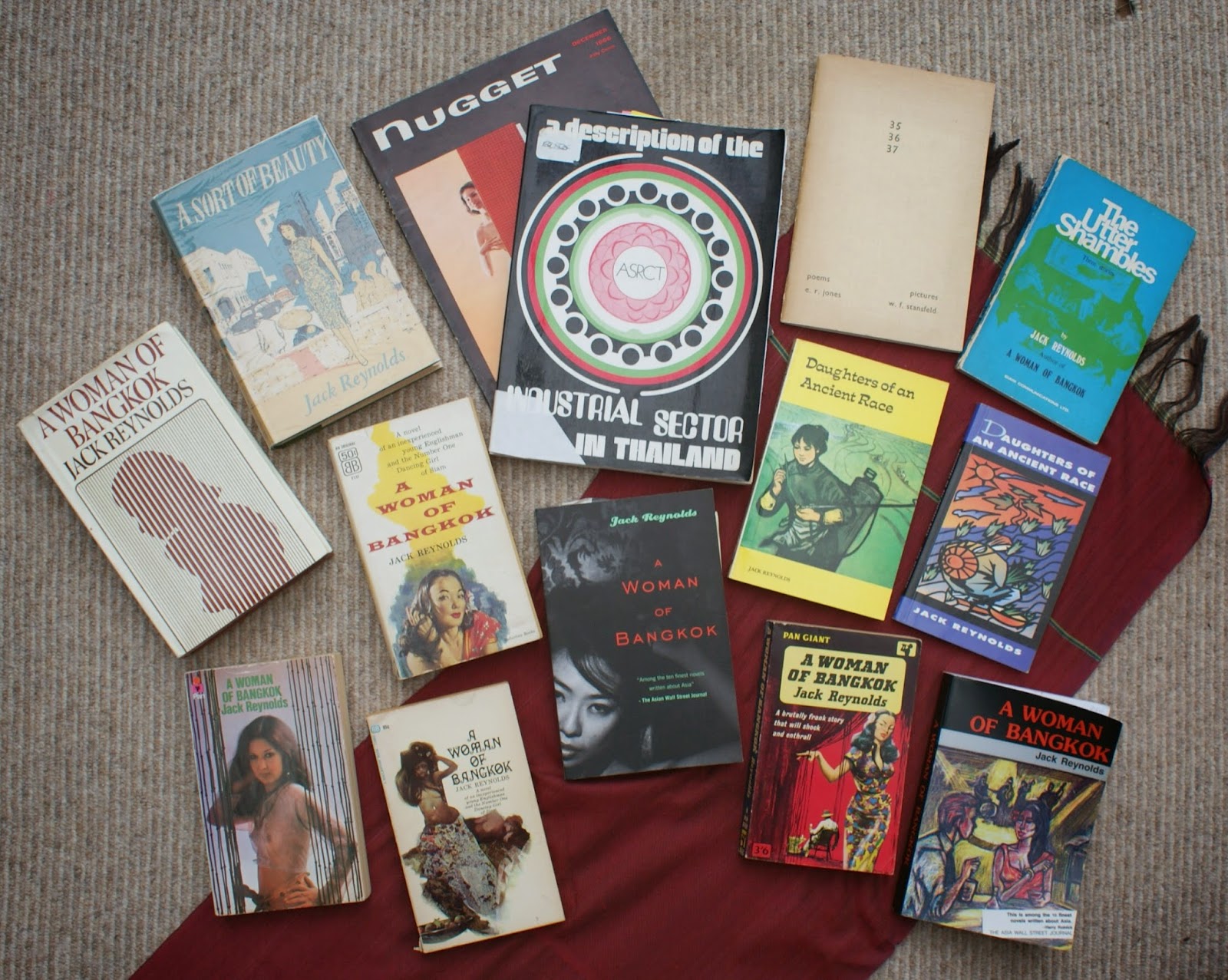
The totally nude image of a sexy and delicious Thai girl on the front cover of the DK Books 1985 edition of Jack Reynolds' extremely seminal novel, "A Woman of Bangkok" would have deeply shocked Vilai, The White Leopard, the aforesaid Bangkok woman and dance hall hostess, the posturing anti-heroine of Reynolds' story. She would never have let herself be seen either in daylight or darkness unless elegantly but alluringly attired, especially at the dance hall. And to be seen in the nude, let alone be photographed, and then to be manhandled for free by an infinite number of smutty book readers would never have been allowed by The Number One Bad Girl of Bangkok. Unless of course she were quite exceptionally well compensated.
(And now a tip... a copy of this rare edition of the book is available at leading second-hand book dealers, DASA on Sukumvit road near the Emporium, but it won't be for long.)


But did The White Leopard really exist and has she ever shown her face since the book came out? What does Trink think? Read on!


The Plot Thickens

My solitary quest to discover the life of ‘Jack Reynolds’, the shadowy author of the 1956 novel, “A Woman of Bangkok” is continuing apace and I’m thoroughly enjoying it. It has become totally absorbing as each new bit of information comes to light, but there are so many leads to follow up that I’m overwhelmed.

If you scan down this article, you’ll find a list of key questions and with these I really do need your help, especially as I am not in Bangkok to do any of the hands on research.

Can you answer any of the questions for me? Could you yourself go and dig out some of the answers even, in a common effort to produce a brief account of Jack’s life? (Eg Employment records at UNICEF or The Bangkok Post.)

Most dramatically, I now have a photo of the Christian headstone to Jack’s grave, though I don’t know yet where it is exactly. It shows him as Jack Reynolds Jones, his wife Wanpen Muthikul Jones. He was born 1st June 1913 and he died on 8th September 1984, just over twenty five years ago, aged seventy one. A photograph shows a man with glasses, dark hair and a square lantern jaw. An empty space awaits the picture of his widow.

My previous article below describes the extraordinary phenomenon of this talented writer producing a first novel about the very accommodating woman of Bangkok which bursts upon the world just a year after Frank Mason’s, “The World of Suzy Wong”. The book reputedly sold more than a million copies, but apart from one serious non-fiction work about China, its author then disappears almost without trace. The people around him would of course deny this but in truth there is no public record of his life. I’m now trying to find those who did know him and to fill the void with a short history of Jack Reynolds. The few thousand words I plan seem to be growing though as the information flows in.

One new and unique source is the unpublished book written by pioneering Oxfam stalwart, Bernard Llewellyn in the late eighties. His remarkable manuscript book called, “A Traveller in the Third World – The Memoirs of An Itinerant Do-Gooder, 1940-1982” should definitely see the light of day, though that’s another story. The point is that outside of his family and a few friends from Oxfam, I am privileged to be the first person to read it… and there are four fascinating passages about Jack. Bernard and Jack worked together in the Friends Ambulance Unit in China during the war years and with much in common as the England born sons of Christian Ministers with Welsh origins and as conscientious objectors, they quickly became firm friends.

One rather poignant passage in the book goes some way towards explaining Jack’s failure to produce another novel.

Llewellyn writes that when he visited Jack in Bangkok in 1957, the year after “A Woman of Bangkok” was published, Jack, “was making heavy weather of his more serious work. His novel had taken months to write and rewrite; but in 1957 “A Woman of Bangkok” had finally appeared. He wrote it using his mother’s maiden name: the nom de plume, Jack Reynolds. Though we did not know it in 1957, this was to be Jack’s sole full-length novel. Some shorter pieces were later to be collected and produced in paper-back [this was presumably “Daughters of an Ancient Race”, Heinemann 1974] but nothing was to cap his early achievement.

The picaresque adventures along Chinese and Thai roads which made his letters such fun to receive for the most part never found their way into print ; though he was to send me in the sixties a summary of the plots and the characters around which nine separate books were to be written. But Jack could never quite settle to complete them one at a time and, in his mind, one story merged into another and he wrote and rewrote until the accumulation of material confronted him with an impossible task. Nor was the literary problem the only thing on his mind. Family life and the problem of earning a living in a country of infinite distractions held back the flowering of what seemed to me a prodigious talent.”

Jack’s protagonist in the novel, Reginald Joyce was a tormented character torn between the biblical strictures instilled into him by his Christian Minister father and his own more tearaway tendencies. In the book Reggie escapes his upbringing in Bangkok by taking to booze and easy women with a huge appetite, but all the time racked with guilt and recriminations.

Given the autobiographical implications of the novel, perhaps Jack too was a complex character and I hope his old friends can tell me more. I have received two personal reminiscences suggesting that in his later years his joy in writing had turned to dust and that he suffered a terminal case of writer’s block. There was also mention of an article called something like, “The Ghost of Soi ??” that appeared somewhere in the Bangkok media in which his picture showed him as looking thin and with a whispy grey beard.

Can anyone locate this article?

The great strength of Jack’s book is that it is so precisely observed from life. His picture of Bangkok and of Reggie’s arduous drives up to Korat are passionate and vivid. Thus one inevitably asks, who was the inspiration for Vilai, ‘the woman of Bangkok’, known otherwise as The White Leopard of the Bolero dance hall and the bitter rival of The Black Leopard. Were they too and the Bolero itself drawn from life and who exactly were they?

It seems I may now have an answer. My informant, now in his nineties, tells me as follows (after some editing).

“The Bolero was the Cathay, an open air Bangkok dance hall with a concrete floor and Mekhong and Singha on offer. It had a roof, a bit of a bandstand and sometimes serviceable toilets. There was also Thai food available. The girls sold drinks and tickets to dance with them. It was mostly Thai men as there were very few farang then. At both the Cathay and the Hoi Ten Lao, a famous six storey restaurant with a nightclub on the top floor, the White Tiger and the Black Tiger were the mainstays. (They were of course Jack’s inspiration for his characters in the ‘Bolero’.) The Black, as I think it was, moved on and set up shop elsewhere until the nineties. One of the Tigers, I think the White, got sick and spent all her savings on doctors but died anyway in the sixties.”

A number of sources, based probably on published interviews that Jack later gave, say that he and the White Tiger were firm friends and saw each other every New Year for many years and that it was a probem for him keeping her identity private. However, later on when Jack was in declining health, she had eventually failed to show up to see him.

About six years ago (?), Bernard Trink, presumably in his Nite Owl column in the Bangkok Post, said he saw the White one in a Sukhumvit bar playing pool. This is what he said.

“If you didn’t read Jack Reynolds’ “A Woman of Bangkok”, long considered the literary classic about the night life of the metropolis, skip this item. Believe it or not, its White Leopard heroine was seen shooting pool a week ago at Rajah Hotel’s Hillary Bar (Soi 4 off Sukhumvit). Her name, incidentally, is Muck. And her personality is much the same as when Jack wrote about her.”

It would be fascinating to resolve this mystery though the ‘facts’ must by their nature always remain shadowy. Of greatest interest would be to see Jack’s version of things, if any of the contemporary published interviews can be found.

So when exactly was Jack doing his literary ‘research’ in Bangkok and when would he have discovered the ‘Bangkok woman’ of his story?

He had arrived in Bangkok to work with UNICEF in 1951 but he surely must have enjoyed R&R visits from China before then.(????) By the time of Llewellyn’s visit in 1957, he was married to Pen with two kids and another on the way. If, as in the book, the White Tiger was about thirty at the beginning of the fifties, by say the year 2000, at eighty years old she would have been one of the older chicks playing pool in the Hillary Bar. Or perhaps she was only seventy. Or perhaps it wasn’t her at all.

NOW FOR A FEW QUESTIONS

1. I am failing to pinpoint the time scale precisely for Jack’s working life in Bangkok. It seems to go something like this.

- 1951 UNICEF aged 38, and then a posting to the Middle East in 1960 (Llewellyn.)

- 1960s(?) Working at The Bangkok World and The Bangkok Post, aged 47-57 (???)

- early seventies with The Investor, then to a UN job in Africa (Jim Shaw believes)

- then what. Some dates for all of this would be good.

- and when did he work in Indonesia, the Philippines and Nigeria, as the 1974 book bio says?

2. Can anyone send me an image of the cover of their copy of the book to arhicks56@hotmail.com, please.

3. Can anyone come up with his Bangkok Post obituary (died 8 September 1984) or with any other articles, eg ‘Living in Thailand ‘in 1983. (My two money cards failed to pay for access to the Post’s archives which may only go back to 1992 anyway.)

4. Can anyone identify Megapoint of Kwun Tong, Hong Kong who has posted on a forum about Jack.

5. And how about Jack’s widow, Wanpen Muthikul Jones? And their seven children, including David, Philip, Steven Muthikul Jones, a successful sculptor, and reputedly another son who is a scholar and has published in the Journal of the Siam Society. Most importantly can someone do web searches for them in the Thai language (remembering that they are probably Joneses but could be Reynolds), which is beyond my expertise.

6. A biographer would of course get a copy of Jack’s English birth certificate (Emrys Reynolds Jones, born Hertfordshire, 1 June 1913.) And Thai records of marriage, death and probate of a will.

7. UNICEF should have full employment records and so should The Bangkok Post.

8. DK Books were presumably in touch with the family when, after Jack’s death, the book was printed by them in 1985 and 1992.

9. There are key people who have memories, including the aforesaid Trink. Also William Warren, John Everingham, Roger Crutchley, S. Tsow, Jason Schoonover, Sterling Seagrave,, Colin Piprell and many more who, though of course younger, may have crossed paths with the great author. Who were his immediate colleagues at The Bangkok Post. Has the experience killed them all?

10. Finally Vilai herself. She tells Reggie that this is only her nick name, so what does it mean? The European colonizers justified their intrusions as a civilizing mission but the Thais successfully resisted them, claiming that they were already ‘si vilai’. Is this the same word as her name and what does it mean exactly?

So who can help me with any of the above?! Who will leave a Comment or email me?

My family here in the village in Surin is wondering what I’m doing spending even more time steaming at my computer than usual and it could start causing problems.

Andrew Hicks The ‘Thai Girl’ Blog November 2009

Saturday, 7 November 2009

"A Woman of Bangkok"


The 1985 edition by Duang Kamol

The book cover shows Aberdeen harbour, Hong Kong in 1957.

I took these pictures in Aberdeen in the late seventies.


What Ever Became of Jack Reynolds?

At the end of this blog there’s a serious request for information from you. I’d like to learn more about Jack Reynolds and to share what I discover in a later article… so please read on.

*****************************************************

Coincidentally I’ve just found copies of two out of print books about Thailand that I’ve long been looking for.

“A Woman of Bangkok”, the seminal novel by Jack Reynolds (first published in 1956 as,“A Sort of Beauty”), is a classic ‘Suzie Wong’ story set in fifties Bangkok, while “With My Back to the East” by Bernard Llewellyn published a year later is an elegant account by an established travel writer of his journey through seven South East Asian countries, including Thailand.

The first one I found in Gecko Books in Chiang Mai, surely Thailand’s biggest second-hand bookshop, while the Llewellyn was found for me by a sharp eyed friend in a second hand book shop in Bangkok.

A curious link between the two books is that much of Llewellyn’s chapter on Thailand is about how when in Bangkok he stayed with his old friend Jack Reynolds and how they travelled up to Korat by jeep together.

For me there’s a more personal link as well.

When I was lecturing in law at Hong Kong University in the late seventies, Bernard Llewellyn, then working for Oxfam, used to come and stay with me in my spacious university flat overlooking the western approaches in Pokfulam and became a good friend. Perhaps it was in character that he never talked about his books and this is the first time I‘ve managed to find one of them.

I mentioned Bernard’s name in a recent article on this blog about my volunteer work with Oxfam (‘Can Oxfam Really Help Thailand’s Poor?’, 22 August 2009) and such is the power of the internet that his now middle-aged son, Michael, then emailed me to get in touch. Bernard had published four travel books and Michael told me that he was working on a fifth not so long before he died aged 88 in 2008.

This unpublished book covers much of his active life from the time he joined the Friends Ambulance Unit in China during the Second World War, through his first travels in the East until his retirement from Oxfam in the 1980s and so it should be a fascinating read. Michael has now sent me a pdf file of the book and I am much looking forward to printing it out and reading it. Bernard’s obituary can be found in The Guardian of 24 June 2008. (And sadly that of another Oxfam friend who was with the Friends Ambulance Unit, Michael Harris was published in The Independent on 8June 2009.)

I’ve also long been curious to read Jack Reynolds’, “A Woman of Bangkok” as it is celebrated as the first of the many ‘expat’ Bangkok novels written by and about western men falling for and foul of rapacious bar ladies in this, the Land of Seductive Smiles.

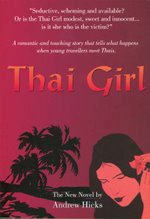
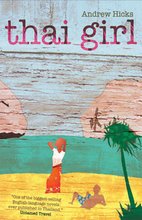
My own solo novel, “Thai Girl”, the story of young British traveler, Ben who gets entangled with a pretty beach masseuse called Fon, has been described by one reviewer as ‘the definitive novel about relations between Thais and foreigners’.

Others say that this accolade should instead go to Jack Reynolds’ story, even though it’s now already half a century old. I’ve seen comparisons made between the two novels in discussions on an internet forum, so I was very curious to see what I’d think of his book.

“A Woman of Bangkok” is the story of Reginald Ernest Joyce, a virginal and mildly irritating twenty five year old Englishman who sells vegetables in a grocers’shop. The guilt ridden son of a rural vicar, he only comes to life, it seems, when he races motorbikes on the speedway track. Could it be coincidental then that Jack Reynolds likewise rode speedway and was the son of a vicar? I’ve read too that Reynolds’ real name was Emrys Reynolds Jones which bears more than a passing resemblance to Reginald Ernest Joyce.

The story starts when lettuce seller Reginald is jilted by his girlfriend, Sheila. She, the hussy, then gets off with his older brother who is clearly more of a man than he. Reggie then takes up a three year contract as a commercial salesman based in Bangkok where he falls defenseless into the clutches of the self-styled ‘White Leopard’, the eponymous ‘woman of Bangkok’. A bar girl of the most mercenary kind who mercilessly parts him from his money, she is soon to be the cause of his disgrace and sudden return to England at the end of the book.

Though much in the book could be autobiographical, Reynolds paints Reggie as a misfit who fails at everything he tries to do, including suicide and seducing Sheila. The critical turning point in his life when he fails to screw his courage to the sticking point is lyrically told by him in the first person as follows.

“Oh, Sheila, Sheila, Sheila. Lying there moaning in the heather. My hand on your heart. My hand under your head. The odour of your hair and skin, as sweet as the heather. Your tense repeated cry: “No Reggie, no. Don’t do anything we’ll regret – please…” I got up and walked stiffly (?!?) twenty feet away. I shouldn’t have been so soft. In fact I was a fool. I let her appeal to the Ivanhoe in me, the medieval Sahib.”

Big brother then apparently seizes both the initiative and Sheila and drags her off to the altar, leaving Reggie twisted and bitter towards women and life in general. Later Sheila tells Reggie that after he’d left her moaning in the heather, “you came back looking all noble like Sir Galahad and no doubt with a new poem in your head”. Reggie replies, “What did you expect me to do – rape you?” “Why not?” says the feisty Sheila.

Reggie rages thus. “Half the human beings in the world are female. The breed is produced by the busload. Billions of the bitches. And every one of them stamped in the same press.”

Thus in the world according to Reggie, when a euro-sheila says no she really means yes, but he soon discovers that certain Thai women in bars know the precise meaning of ‘yes’ if adequately compensated.

Reggie is thus bedeviled by his Christian guilt about sex, torn between perceiving women as bitches in need of a mate and as unsullied beings to be wooed according to the conventions of courtly love. As an outlet for his frustration Reggie has angrily penned a novel called “Perfidy” about how a perfect gentle knight such as he is done over by perfidious women. It expresses ‘the rage of a jilted lover’, says Reggie. It is ‘an outpouring of rage’, full of ‘plummy writing. Over-ripe Victorias. Every semi-colon is like a plum stone in a plum pie’.

The only difference is that while Reggie tore up his fledgling novel in fury, Jack Reynolds got his successfully published.

Thousands of readers have thus since learned that Reggie had a middle-aged landlady in London who took a big shine to him and he, it appears, to her fifties-style legs. In Reynolds words, her calves ‘twinkle fawn-stockinged between this evening’s particular flowery voluminousness and her run-over-at-heels but meticulously-polished shoes.’

The style of the book is sometimes elegant but even for its time is sometimes seriously over-written and slow. My writers’ group back in Exeter would have hammered it for its plummy writing and adjectival retentiveness.

As the story unfolds in Thailand, there’s a premature climax (if I may call it that) when Reggie goes on his first business trip to Korat by jeep with his Thai colleagues and they go to a local pick-up joint. While the Thais freely indulge, Reggie fights shy and goes home, only to slip out and later return to the scene. There at last he loses a few baht and his innocence.

“My pistol-butt is no longer un-notched; my belt is hung with scalps,” he boasts. In this, his first short trip to Isaan Reggie then manages to collect another seventeen ‘scalps’.

Bernard Llewellyn in “With My Back To The East” writes as follows of his own trip to Korat by jeep with Jack.

“We ate that night in one of the restaurants across the water. It was the place – so Jack said, and he should have known – where Ronnie (sic) Joyce, the long-suffering hero of his novel, and his friends had their hilarious meal preparatory to the loss of Ronnie’s virtue in the Korat back streets.”

Once back in Bangkok, Reggie falls into the clutches of Vilai, ‘the White Leopard’ at a dance hall called the Bolero, but sadly for Reggie Vilai is unutterably vile.

Reggie is soon besotted though and meekly reaches for his wallet at her every demand. She bleeds him dry, trying every trick in the book, a money-Dracula of the worst kind, without any redeeming features or even any apparent charm.

Reynolds takes pains to make her as detestable as possible and lacking in any positive human qualities. She spends three to five hours every day putting on her makeup and tarting herself up for the night. Her great pleasure in life is plucking her arm pits with tweezers. She pisses on the shower floor instead of in the squatter. She is despicably unpleasant to her servants and anyone beneath her and, what’s worse, she kicks the little puppy.

Just after a fortune teller has predicted his death, her small son is hit by ‘a long green beautiful car’ which ‘moved with the silent deadly stealth of an arrow’. Reggie then scoops him up, badly injured, and puts him on the back seat of his car. Reluctant to sit in the back with him as he’s dirty from rolling in the road, Vilai strongly resists taking him to a hospital as she wants to get ready for work at the Bolero. It’s Saturday night and there’ll be lots of American there.

When Reggie insists on taking the child to the hospital, she extracts a pile of money to pay the doctors’ fees. She then goes off to the Bolero and when the boy dies she blames Reggie for killing him as he took him to a hospital that would never care for him properly. She then makes him pay all the funeral costs.

Later when Reggie has just driven up to Korat on business, she sends him a telegram to say she’s in serious trouble and needs him to come back urgently. Despite being exhausted after the long drive, he then immediately abandons his colleagues and his work and in torrential rain and in the dark heads back to Bangkok in the firm’s jeep to find her. In consequence he has a bad crash and nearly kills himself.

When he finds Vilai, she slags him off for coming to her house covered in mud and gore, demands a huge sum of money from him to deal with some unspecified crisis and when he says he hasn’t got that much, tells him he’s lying. He’s not good to her like he was before, she says, and she’ll never speak to him again if he doesn’t come up with the money.

Knowing that he’ll now lose his job for going absent and wrecking the jeep and having no money to give to Vilai, he decides to go that night to his boss’s house and to steal his wife’s jewels for her. There’s then a melodramatic scene in the last few pages when he takes a samlor from the Giant Swing to the National Stadium, then a tram (not the Skytrain) past the British Embassy to the house in Bangkapi. There he creeps up to the darkened house and goes inside, contemplating murder if it’s necessary to get the jewels for Vilai. Surprising the poor lady sitting in her bedroom in front of her mirror in a pink nightdress, his boss walks in and the game is then well and truly up for dear Reggie.

By this stage I wasn’t too bothered about what was going to happen to Reynolds’ protagonist anyway as both Reynolds and Reggie had lost the plot as far as I was concerned. I fully accept that bar ladies may sometimes be single minded in their calling and that western men can be extraordinarily naïve, especially when fixated on rescuing a whore with a heart of gold. In my view, however, the extent of Reggie’s fixation for Vilai pushes the bounds of credibility too far, given that she is just so very vain, vile and obnoxious. As described, she gives off no great erotic charge and does nothing to explain the extraordinary hold she has over Reggie in the face of her grotesque treatment of him.

Much of Vilai’s dialogue is cleverly written, authentic and funny, but top scoring bar girls have charisma and charm while Vilai has very little. It’s evident that she’s already over the hill and getting past her screw by date too, so she’s not even very attractive any more. Occasionally she turns on some crocodile tears and plastic affection to manipulate poor Reggie but she is otherwise without any redeeming qualities. Nor, apart from three feckless husbands in her past, does Reynolds explain what has made her such a demon.

There is brief mention of her past as a village girl fondly remembering better times, but that is perhaps universal for those who seek a better life in the city. As a character with a single dimension, she is for me, a cardboard cut out whose exaggerated persona is over the top. ‘Money [is] the most important thing in the world’ for all bar girls but they have to be nicer than this to get it.

Despite its many qualities, the story therefore did not work too well for me. I could not suspend disbelief. While Reggie is a well developed character, even if not a sympathetic one, Vilai is merely a clever caricature. While many of the details about Bangkok and Thailand in the fifties are well observed, again they are hardly affectionate or positive, which is strange as Reynolds must have loved the place.

I’m sure that for a western man who’s been devoured whole, wallet and all, by a bar girl, this book says it all, but frankly it wasn’t for me. It struck me it was not so much about the ‘woman of Bangkok’ as about the post-Christian complexes of poor Reggie, crucified both by Sheila who said no and by Vilai who’d say yes for money but could never return his love.

The book is therefore quite unlike my own novel, “Thai Girl”, which is about Ben’s struggle to understand the Thai girl, Fon. Thus he talks to her at length about her childhood of poverty in Isaan and insists on going to her home in Buriram to meet her Mama. Unlike Vilai, Fon is not a bar girl and persistently says no to Ben, so there are major differences in the two stories. They are comparable perhaps because both explore relationships between foreigners and Thais, but in very different ways.

They end differently too. While Reggie’s DC6 takes off from the airport in Bangkok on the last page of the book, on the last page of “Thai Girl” Ben’s jumbo jet lands in a wet and dismal London.

Nonetheless, “A Woman of Bangkok” is a remarkable period piece that makes me more than curious about its author. Banned, it’s said, in Australia, it must have taken great courage to write and to publish it. In an era when Lady Chatterley and Fanny Hill were being prosecuted for obscenity, a story about prost****ion and men having s*x with the n*tives just really wasn’t the done thing. But is it a great book?

In my own view there are few really fine novels, such as Greene’s, ‘The Quiet American’, but many bad ones like ‘Moby Dick’, ‘The Davinci Code’ and those endless Barry Potter books. Of the rest you may either enjoy them or be disappointed and Reynolds’ book is one of these. I enjoyed it as a period piece and because it was about Thailand but nothing more.

Nonetheless, I’m intrigued to learn more about the life of Jack Reynolds. I know that he was a conscientious objector and during the Second World War was with Bernard Llewellyn in The Friends Ambulance Unit in China. This expertise in transport presumably brought him his job with Unicef in Bangkok.

Little bits of information about him keep surfacing. Enjoying a beer at Kinnaree with Jerry Hopkins in Sukhumvit soi 8 the other evening, Jerry told me that Reynolds had lived in that very soi. He’d written for The World, then the only English language paper and the internet tells me that he had a book of stories about his experiences in China called, “Daughters Of An Ancient Race” published by Heinemann in 1974.

Llewellyn’s book says that Jack was married to a Thai village girl who spoke no English and didn’t enjoy her visit to England. At that time he had two sons called Philip and David, and another on the way. Other accounts credit him with between seven and nine children, though perhaps even he didn’t know the score. The children must be in their fifties today but where are they now? Has the book finally gone out of print because it’s an embarrassment to them? Reynolds is said to have died twenty years ago but again I can find no details as to where or when.

On one of the internet forums, an American called Jim Shaw who’d worked with him on ‘The Investor’ in the period from 1970 to 1975 said recently that after losing touch with him he’d visited soi 8 sometime in the eighties to try to discover what had happened to him but he’d learned nothing. (See www.tfs2m.com). And so the plot thickens.

Though Reynolds pre-dates the internet era, Google searches turn up quite a few results on him but many of these ask the same question as this article. Who was Jack Reynolds and what ever happened to him and his many children?

So can you tell me anything more about Jack Reynolds? If so do please post a Comment on this blog or contact me at arhicks56@hotmail.com.

What was his real name and the surname of his children? How and when did he die? Can you give details of your copy of his book with names, publishers etc? And did the novels Bernard says he was working on when he visited ever see the light of day? It would be good to compile a simple bibliography of his writings.

In the fullness of time I will then try to put together a summary of what I’ve learned and to post it on this blog. If enough is reliably discovered, perhaps it should go on Wikipedia.

It should be perfectly possible to discover what happened to Jack Reynolds but only with your help!

**********************************************************************************

Incidentally, I’ve just learned that a fine early copy of Reynolds’ book in its original dust jacket is available at the Librarie du Siam et des Colonies which is near Pantip Plaza. It isn’t cheap but you could email cgsiam@cgsiam.com to secure it. .

Andrew Hicks The ‘Thai Girl’ Blog November 2009

Saturday, 31 October 2009

How The Trains Made Thailand


Bangkok's Hualampong station - waiting to go northwards.

But for Thais even eternal waiting can and should be fun.

An advert for Tiffy recalls the dramatic era of steam.

The station's busy with men in uniforms and local trains too.

The gateway to Chiang Mai and our train on the left platform.

The plains were flooded and it was still pouring by Lamphun.

At Lampang there was a fine old steam engine on display.

Wheels and couplings speak loudly as we clatter over a culvert.

There's light at the end of many a tunnel up in the mountains.

One of many mountain stations, much loved and immaculately maintained.


Nations are defined by wars and geography but it was its railways that finally integrated Thailand within its permanent borders.

Cat and I have just been on the overnight train from Bangkok to Chiang Mai and the journey back by day has reminded me what an extraordinary feat it was to construct a railway across the plains, through almost impenetrable jungle and mountains and up to the ancient kingdom of Lanna.

We’ve also recently been through the humiliating and barbaric process of applying for visas for Cat, both to go to the UK and also to get a Schengen visa for Europe. There is a link there somewhere!

After millennia of tribal warfare, the Schengen agreement between twenty one European nations now allows visitors to obtain a single visa valid for all these countries. How civilized it is to freely cross borders and how very sad that the UK stood apart and did not sign up to this accord. If only we now had just one visa to apply for on going to Europe.

Ease of travel in a modern world means that strict national borders are needed to separate and divide people, but we’re now so used to this intrusion that it’s easy to forget that the nation state itself is a brand new concept. Likewise, passports are something of a new thing. Italy and Germany are new countries and the United States was quite recently defined by its civil war.

And Thailand as we now know it is new too.

Relating things to my own lifespan, a warring Europe was pacified, the invaders were turned back and an extraordinary reconciliation was begun only two years before my birth. And not long ago Africa was abruptly carved into more than thirty artificial nations by the European powers at the end of the nineteenth century, driven on by the insatiable demands of their missionaries and traders. This all happened a mere twenty years before my father’s birth.

Despite the artificiality of some of the borders thus created, even in Africa the nation state has been extraordinarily successful with remarkably few annexations or secessions. Just like Vietnam’s eviction of Pol Pot from Cambodia, nobody liked it when Tanzania kicked Idi Amin out of Uganda as borders are sacrosanct and must not be violated even for good reason.

Eritrea successfully broke away from Ethiopia and Morocco has been too acquisitive, but the fledgling ‘state’ of Biafra, the biggest ever secession failed and Nigeria, Africa’s giant, remained intact, as does almost all of the late nineteenth century political map of the continent.

Now taught an assertive brand of nationalism, modern Thais may look at a map of South East Asia and believe that theirs is an ancient Kingdom but, as defined by its present borders, like so many other nations, relatively speaking it’s brand spanking new.

So what’s the story and why is this so?

Throughout history, where land is divided by insurmountable mountains, rivers and seas, political entities must of necessity be small and this region was no different in that respect. The old civilization of the Chao Phaya basin, of Sukotai and Ayutaya which lie at the core of Thailand, was closed off by mountains to the west, north and east. Those to the North isolated it from the kingdom of Lanna/ Chiang Mai, while the mountains to the east ensured that the Korat plateau and Isaan looked eastwards and could not be fully integrated by ‘the Thais’ from the west.

Thus the loose ‘empires’ of Burma, Thailand and Cambodia, not yet nations with settled borders, were in perpetual conflict as they sought to control the small vassal states around them and to extend their spheres of influence.

The mountains were of course the defining factor. But if you move mountains, everything changes, and that’s exactly what the railways achieved. During the reign of King Chulalongkorn, truly the architect and father of Thailand, construction of the great railways to the south, to the north and east of Thailand was courageously begun.

I’ve previously written of how the feat of cutting a railway over the mountains to Ubon in the east enabled Isaan to be better absorbed into a unified nation… which ironically the current political tensions suggest has not yet been perfectly achieved. (See ‘Last Train From Sikoraphum’ posted on this blog on 14 November 2008)

So now I want to tell you of our long daytime journey back from Chiang Mai by train, a slow and spectacular ride down through the mountains that again reminded me that before 1921 when the railway was finished, Chiang Mai and the Lanna kingdom was another world, a veritable Shangri La, hidden from the Thailand of the southern plains.

In the last few decades air travel has given us seven league boots and made the world smaller but the railways had a far greater impact than that. As a major breakthough in transportation, they redefined much of the political world, allowing access to outlying areas that could now be integrated politically and commercially exploited.

Not least of all this is how it happened in Thailand. It was the railways that were the essential means to make the nation what it is now.

The financing and construction of the Thai railways was a modern marvel of political will, organization and engineering. Crossing the plains was easy but surveying a route through the mountains, building cuttings, embankments, bridges and tunnels, especially a long one through the Khun Tan mountain, must have seemed an impossible project. At last the dream was achieved and served its purpose, though now the line is desperately in need of modernisation and has been left to gently molder in the shadow of its past glory.

Thus as the Chiang Mai train slowly approaches a tiny station high in the northern mountains, the station master is in his old clothes, busy manicuring its immaculate garden. He snaps to attention and rushes off to buff up his boots and to put on his best uniform and peaked cap. Just in time he grabs his green and red flags and makes it onto the platform as the train rumbles in.

Yes, they still wave their flags and they ding a big, polished brass bell to send the trains on their way. It’s just wonderful and nothing, but nothing seems to have changed. Steam has been exchanged for diesel, but the Thai railways still offer a perfect time warp for any nostalgic lover of the world’s quaintest old railways.

Not only travelling hopefully to Chiang Mai is fun but arriving’s even better. As always I greatly enjoyed the city and although it’s changed and grown, the atmosphere is much the same inside the moat as it was when I first visited and stayed in the seventies. The rice fields and mountains are still there too and rural life goes on much as it always has done. And so also do the trains.

The railway is thus the perfect link to help you to slow down and to take you from the madness of Bangkok to that other more gentle world of Chiang Mai. Even Bangkok’s Hualampong Station where your journey begins has been nicely restored and it retains its fine architecture and a polite otherworldliness.

It is always vibrant with people and activity but for Bangkok it’s strangely calm and orderly. The central hall is packed with people, but they just sit on the floor with their luggage surrounding them and they serenely wait as if forever, something the Thais are always so good at doing.

Perhaps they’re pleasantly anticipating the slow ride out through the slums and the shanties built literally feet from the passing trains, out through the sprawling city and onto the endless rice plains. After the long run across the plains, when Chang Mai is not so far away in distance but still a long way in time, their train will abruptly leave the rice fields and climb slowly up into the mountains.

It makes slow progress and you can see the train ahead of you as it rounds the sharp curves. You can feel the extraordinary steepness of the gradients as the train clatters over bridges and culverts. Its single track is but a precarious thread, dwarfed by the mountains and threatened by the encroaching jungle, more like a narrow gauge mountain railway than the important artery that first united Thailand.

In less than a hundred years though the railway has become insignificant and almost an irrelevance. Governments have repeatedly failed to modernize and to invest, caught in a power play with the railway unions who strike to preserve the privileges and inefficiences of an outdated system. It will take strong and determined leadership to give upgrading the railways the priority it deserves, which suggests that nothing much will change in a hurry.

In the meantime I’m not personally complaining about that.

Nothing for me could be better value or fun than a round trip on the train from Bangkok up to Chiang Mai and back. I’ve done it several times before and I hope this time won’t be my last.

@@@@@@@@@@@@@@@@@@@@@2@@@@@@@@@@@@

POSTSCRIPT… I’m no historian and have done no research whatsoever to write this piece so if you find it’s riddled with inaccuracies or can tell us more about the story of the railways, do please leave a Comment on this blog.


Andrew Hicks The “Thai Girl” Blog November 2009

Thursday, 22 October 2009

Andrew Hicks Is A Bastard! - Official.


My two modest books about Thailand have fared quite well at the hands of reviewers in the media but I do have some ‘issues’ about book reviews in general. Often, I think, they’re pretentious, ridiculous and corrupt.

Some time ago, I wrote a blog about the overblown extracts from media reviews printed inside the dust jackets of novels by the top selling 'Johns', Grisham and Irving. It wasn’t professional jealousy that got me onto this topic, just my observation that the obsequious quotes that get splattered all over ‘international bestsellers’ are often the utterest of utter crap!

[See ‘Dear John, I’m Confused’ on this blog at 17 October 2008.]

Before my very own book, “My Thai Girl and I” went to press, I thought of soliciting ringing endorsements from top authors such as J.K. Rowling (who was at my very own University of Exeter) or Dan Brown (who wasn’t, though he taught at Philips Exeter) and then I could stick them on the back cover. But frankly I couldn’t be bothered. Nobody would believe anything they said anyway so I decided to write my own glowing endorsements instead.

Thus “My Thai Girl and I’, according to the back cover, is, “One of the funniest books I’ve read all week”, “A feast for feminists”, and “Hicks at his best”.

No buyer will be swung either way by any of this, so why not make a spoof out of it! And as few book reviews are ever truly independent or free of an agenda of some sort, the majority of them come across as total rubbish.

Except that book reviews can occasionally be genuine!! And it’s a big exception!

The very best are independent reviews posted on the web and my favouite is one written by an Aussie fireman called Eric.

I don’t know him from Adam but he’s got a great blog at http://firemaneric.blogspot.com and I’d recommend it to you as a rattlingly good read.

You see fireman Eric came to Thailand and as Thai ladies like firemen and as Eric fell for a Thai lady, the rest is hysteria. In the strange way we Western males sometimes have, just like me, he felt compelled to write a blog about his utterly unique romantic experiences in the Land of Increasingly Foolish Smiles.

And, despite being kind of busy, he managed to read “My Thai Girl and I”, not once but several times. The story in my book rang bells for him and, it seems, he liked it quite a lot.

Then in an independent and uncorrupt way, he couldn’t restrain the urge to write a review about the book and to post it on his blog.

I am not dismayed by this, despite being a modest person who shuns the limelight, but I shall now paste in his review below in order to showcase the snappy and readable quality of Eric’s writing.

For me, this review is lit crit of a very special kind. The web can be cruel and anonymous but when I get an accolade like this, I value it very highly. That someone has enjoyed my book means a lot to me.

Thanks Eric, you Aussie bastard!

So here’s a fireman’s review of “My Thai Girl and I”.

Complete and unexpurgated!


03 September 2009

Andrew Hicks Is A Bastard! - a book review.

I’ve never done a book review before, so this is something very new for me, but this is one book that I cannot help but share with everyone.

The book in question is, of course, “My Thai Girl and I”, Andrew Hicks’ tale of woe, happiness, frustration and bewilderment as he goes from being a divorced sixty-something retiree to the husband of a ball of energy and “Thai logic” half his age – the enigmatic Cat.

I first heard about Andrew’s book on the ‘net’ – as one seems to hear about many things these days – and, after having a look at the website and reading Andrew’s blog, I decided that it was worth a read. I finally managed to pick up a copy from Asia Books’ at the airport in Bangkok at the end of my recent trip to Thailand. I only wish I’d found it earlier.

Despite my best intentions, and having promised myself I would only read one short chapter every evening, I read the book in three late-night sittings – I simply couldn’t put it down – before handing it to one of my mates to read. Now I’ve got it back (only a week later) I’m reading it again and finding it even more enjoyable the second time around.

This is Andrew's second book written about Thailand. His first book, "Thai Girl", a best-seller in its own right, is something altogether different, telling a fictional tale of a young traveller who meets, falls in love with and, ultimately, loses a Thai girl. You can find out all about "Thai Girl" on the same website, here, a little down the page.

We start our journey with Andrew as he takes a breather in Phuket, one of the more well-known tourist locations in Thailand, as he undertakes a journey of self-discovery following the end of his former life as a corporate Lawyer and Lecturer in Law, brought about by the twin barbs of early retirement and divorce.

As happens many times in life, a chance encounter becomes, in relatively short order, a life-changing experience of a kind that defies explanation – unless you’ve had the same happen to you. Andrew purchases what must go down in history as the most expensive piece of papaya in history – the first step towards the slippery slope leading to the insanity that is known as life in Thailand.

“My Thai Girl and I” chronicles not only that first encounter, but Andrew’s gradual introduction to life in a small village on the rice-growing plains of Isaan – Thailand’s poorest and most remote region. Throughout the book he details the storm that exists around him, as he tries to sit calmly in its eye and learn to “go with the flow”, meeting some of the most colourful characters on the face of this earth and, somehow managing not to go completely insane, slowly adapts his rigid western values and thinking to something closer to the Thai way.

The reader is drawn in to the exciting, illogical and heart-warming string of disasters, joys, projects, travels and events and, before long, is eagerly turning the page to see what happens next.

Some of the stories are amusing, others side-splittingly funny, whilst the occasional sadness of small-village life creeps in elsewhere. Throughout it all, the reader is left wondering what kind of world this is, does such a place truly exist, and where can I find it?

This is the story of the REAL Thailand, far away from the tourist traps and plasticised smiles and tacky façade that westerners think of as Thailand. This is the Thai’s Thailand, the one you won’t find in the glossy tourist brochures or on the TV adverts, the one that few people ever get to see, and we are fortunate to have this rare insight offered to us in the eloquent format which makes “My Thai Girl and I” mandatory reading for anyone who has an interest in Thailand as it really is.

If you’re thinking of travelling to Thailand for something more than bars, beaches and Bangkok, you simply can’t do so until you’ve read “My Thai Girl and I”, lest your brain explode as you try to process the world around you. Even if you’re not going there, “My Thai Girl and I” is a ripping yarn, bloody funny and written for the likes of you and me.

This is one of the few books I have read – one amongst thousands – which left me feeling that it had been written specifically for me. On each page I felt as though I was sitting across a table, cold drink in hand, as Andrew imparted his wisdom and experiences to me, sharing with me the emotional lows and manic highs of his new life. It became personal, poignant and answered many of the questions I had about life in the real Thailand. Written by a mate, for a mate.

Thanks, Andrew, for writing this book for me.

So how does this make Andrew Hicks a bastard?!!

There’s several reasons.

Firstly, Andrew is English – that makes him a bastard from birth. (Remember, I’m an Aussie)

Secondly, he’s living the life that I want. Andrew is laying out, in plain English, the blueprint for the life and lifestyle that I have been dreaming about, so I’m jealous. No matter how you dress it, he and I both know that he’s lucky, a “lucky bastard” as we say here, so there’s the second strike on the bastard count.

Thirdly, many of my friends have suggested that I eventually turn this blog into a book. I don't need to now - it has already been done and "My Thai Girl and I" is far to close to what anything I'd write would look like. Change the names and the town and I think it'd look identical.

Fourthly, did I mention that he’s English?

Finally, you can join the ongoing story of Andrew, Cat and their insane life by visiting Andrew's blog, "Thai Girl", 'The Exotic Adventures of a Literary Sexagenarian' (that means someone in their 60's). Add it to your favourites and you won't be sorry.”

The “Thai Girl” Blog September 2009

Wednesday, 14 October 2009

Still Stalactite Thirty Years On!


Staying in Ralph and Mee's house in the mountains was magic.

Waking up to a sea of clouds made the long journey worthwhile.

Papa cooks breakfast in his bamboo house nearby,

and Mama and her sister enjoy the meal in their bamboo house.

A walk to their tea garden washes away the stresses of the city,

while Papa picks tea leaves under the jungle canopy.

This village tree is a single banyan which puts down tap roots.

Slaughtering a pig seems to be quite a big event,

and everyone is there, anxious for a slice of the action.

We visit the Chiang Dao caves and feed the fish in the temple pond.

And I recognise a stalactite I last photographd thirty years ago.


Tourists to Thailand rush to the sea and islands but for me the forests and mountains are an even greater draw.

Cat and I have just come back to Bangkok after a short holiday in Chiang Mai and it’s been amazing. Walking through the tea plantations high in the mountains, the light falling soft and dappled on the manicured bushes is an uplifting experience. This magical place could hardly be more different to the endless flat rice fields that surround us at home in our north eastern village in Surin province.

We stayed with Ralph and Mee in their modern home in Mee’s Lahu village high in the mountains above Chiang Rai. We arrived in pouring rain but awoke the next day to the vista of a sea of cloud seen from the upstairs balcony.

From then on our stay was a succession of great experiences.

Mee’s parents live there with them, cooking and eating in a traditional split bamboo room right next to the house. Their life retains many of the traditional routines of their mountain upbringing and every day in season they take the long walk to their tea garden to pick twenty kilos of leaves each.

The village is vibrant with life, at night the children playing in the open area by a vast banyan tree and in the day workers go off on their motorcycles to pick tea. Life is much as it is everywhere in a rural community with small shops, a pork butcher and noodle stalls but unusually for Thailand there are three Christian churches.

On our last day Ralph took us down to the valley to visit the Chiang Dao caves, one of the largest limestone cave complexes in Thailand. After we’d fed the massive fish in the temple pond at the approach to the caves we went inside and were hugely impressed by the echoing caverns.

While I was photographing one of the stalactites I suddenly recognized it as an old friend. It was not the caves themselves that I remembered but the photo I’d taken of this river of limestone three decades ago. On thinking back I soon realized I’d been here just a month or two short of thirty years ago.

That time in the seventies the rice harvest was already coming in and the workers were out in the heat of the fields, swathed in clothes to keep out the dust, threshing and winnowing the rice by hand, tossing it on bamboo trays and blowing away the chaff with big fans. The rice was then hauled away on ox carts for storage in their wooden barns, all so very different to how it’s now done in the twenty first century.

Back in Chiang Mai we drove through crowded streets out of town past the university and the temple of Wat Suan Dork, which is now totally hidden behind rows of shops. On that first visit to Chiang Mai the Suan Dork temple was then a sleepy place. It was outside the urban area and into the the countryside.

We also ate at Aroon Rai, a well know eatery on Mool Muang Road. I told the middle aged waitress I’d been there thirty years before and that, as I remembered it, there'd been no bleak concrete building as now and we’d eaten outside in a quiet garden. Yes, I was right, she said, as she’d started working there just three years before that time.

Worryingly I’d forgotten about the Chiang Dao caves but had remembered the restaurant! This time I’ll have to get back there to both of them sooner than thirty years on.

Yes, Chiang Mai has changed. It’s bigger and brasher, though in many ways it feels very much the same… hot, busy and chaotic but so welcoming and I think I’ll always want to come back.

Now I have to survive being in Bangkok again before we go back to the village, still thinking of the peace of the family tea garden in the mountains.

Andrew Hicks The “Thai Girl” Blog October 2009

Thursday, 1 October 2009

No Bamboo In Bamboo Land


Living in the back of beyond in rural Isaan, apart from English newspapers and farang food, there’s not many things you need that you can’t get hold of quite easily. Although there’s bamboo everywhere, including in our back yard, there’s a strange shortage though of stuff made from bamboo.

Yes, you can get pre-Ikea knock-down chip board furniture everywhere and fold-down steel kitchen tables that are totally hideous. But if you want attractive bamboo or rattan furniture for an exotic Eastern look you might as well forget it!

For the locals of course, wicker or rattan smacks of the past and they much prefer fifties chip board chic, but the strange thing is that functional bamboo furniture can be seen everywhere. It’s quite nice and all the little grass roofed eating places in town use it… but can you buy it here?

Not a chance?

After we’d built the house, I’d always wanted a decent bamboo table and chairs so we could eat out on our downstairs verandah, but they’re simply not available anywhere. This puzzled me so I worked on the problem as intensively as a CIA spook for three years until I discovered the truth. Bamboo furniture comes from a bambooish sort of place in Ubon province about three hours away and you can only get it there. Apart perhaps for a few roving pickups loaded to the sky that come round the villages, you can’t buy it here.

Ultimately therefore, three years on, despairing of my old jeep, I had to buy a new pickup and drive to Ubon and find the bamboo shops myself in order to fulfill my farang dream of eating off bamboo furniture.

This minor frustration was recently mirrored in a severe marital tension that has occurred between me and my sweet though straight talking wife, Cat. Just before leaving for a trip to see my family in England the rains began early and it seemed that the gutters round the house were blocked with leaves, probably from the eucalyptus from next door. The result was that they were overflowing in the worst of the downpours and water was cascading down the front of the house and onto my valuable bamboo furniture and precious antique ox cart.

“Cat,” I say to her desperately, “We must get gutter man in to unblock the gutters”.
“Cannot,” says Cat. “In Sangkha not have gutter man.’
“But we only need someone with a ladder who can get up there and do it in a few minutes.”
“But in Sangkha nobody have ladder. I ask already at all the shops.”

I quietly seethe in frustrated disbelief, silently accusing Cat of not being bothered about this disaster and telling me what she wants me to hear.

So it seems that Surin folk don’t do ladders then. When they built our house all those five years ago they did it without a ladder, instead standing on upturned paint tins and climbing painfully up the wooden scaffolding. And nobody in all the builders merchants in town knew of a gutter man, insisted Cat, even though they all sell guttering. And certainly nobody, but nobody in Sangkha has a ladder.

Seriously, Cat tells me, nobody has a ladder because they’re always made of bamboo and bamboo stuff’s made in Ubon and not in Surin.

So we flew off together to England leaving unblocked gutters and torrents of water falling down the front of the house. When we got back, like the mowing, nothing of course had been done about it.

I tackle Cat head on asking her to get it sorted and get one of those ‘kill-at a thousand-paces’ laser looks.

I’ll go and cut some bamboo from around the pond and make a ladder myself if I have to, I tell her. I’ll charter a helicopter to drop me onto the roof. I’ll clear the gutters if it’s the last thing I do… and given the height and the steep pitch of the roof, indeed it might be.

Then Cat’s brother Saniam, taking a break from helping us to cut the ‘lawn’ goes somewhere and walks back about five kilometers to the house carrying on his shoulder a short bamboo ladder. He tells me through alcoholic fumes that he’s going to stand the ladder on the low kitchen roof, climb up and over the top of the house and dig out the gutters for us.

I contemplate scraping his remains off the path at the back of the house and decide to put a damper on the whole thing. Drunk in charge of a ladder is not a good idea Perhaps tomorrow he’ll be sober, I fantasize, but no, it never happens and I soon notice that the ladder has gone.

Then one day I hear Cat’s frantic voice loudly calling me from the back of the house. It must be an invasion from Cambodia, World War Three or the pig’s escaped again. Then I hear what she’s saying to me.

“Andrew, gutter man come. Run, run quickly!”

I’m out of the house in a flash and at the gate and sure enough there’s a modern pickup with a ladder on the roof coming down the soi. Like many Isaan tradesmen, the man who does gutters drives far and wide looking for work, announcing his arrival with an intrusive loudspeaker that can be heard for hundreds of yards. Cat had heard him coming. This was the answer to my prayers.

But shock, horror… all he had on top of his truck was a short bamboo ladder!

Just like Saniam’s plan, this he perched precariously on the kitchen roof and in bare feet scaled up and over the house to clear out the gutters and repair a few leaks. I watched him climbing down again, the foot of the ladder stood on the steep slope of the kitchen roof. It was shocking to see the risks he was daily exposed to through his own casual attitude to life and death. And who would have to pay hospital bills or compensation if he fell? It would be me! Like when a motorbike runs into the side of your car, that’s just the way it works around here.

I’ve written before about the pleasure Cat takes in gathering wild food in the surrounding countryside. I’m quite proud too that we’re self-sufficient in obtaining our own drinking water and have so far lived to tell the tale. While many farang friends buy bottled water, releasing thousands of plastic bottles a year into the wild, we drink real organic rain water.

For six month it rains heavily and a peripheral purpose of the gutters is to channel the sweet water into the three vast ceramic storage vats we have around the house. These usually last us out over the ensuing dry season, so it’s a system that saves both the planet and my satang.

Of course the roof water’s safe, I tell myself. The air’s clean as there’s no industry with only the methane farts of buffaloes to pollute it, and I’ve never had a tummy problem from it.

But then while gutter man was still working away up top, I went around the house and saw the mud and gunge that he’d scraped out of the gutters, dropping it in heaps to the terrace below. I was truly horrified. We’d been drinking water filtered through the leaves and dirt of the five and more years we’ve been living here.

And why this extraordinary negligence with our well being and health? Essentially it’s because this is Surin and not Ubon and here they don’t make bamboo ladders. So that’s why until now we’ve never once managed to get the gutters cleaned out.

What might be a good idea would be for me to get in the pickup, drive the three hours to Ubon and buy a ladder so I can do it myself in future.

But no, I’ll buy ten of them at a good discount and I’ll cruise round the town and villages selling them. Then that way the ladder famine in Surin will in part be relieved.

While I’m at it I might as well get some tables and chairs and sell them too!

Andrew Hicks The “Thai Girl” Blog October 2009

Sunday, 27 September 2009

Her Papa's A Hunter Gatherer!


In the West there's food aplenty and Pooh Bear and Tigger can get fat on sweet cup cakes. Here in Isaan, the poor North East of Thailand, they have plastic plates but little to put on them. Tiny crabs, shrimps and shell fish are gathered from the flooded rice fields and add flavour to the rice. There's a long tradition of hunting and gathering though it's not possible now to make a living from the forests.


Fish caught in the outfall from our pond.

A bucket of bamboo shoots cut from around the pond.

Cat spent hours chopping and boiling to make them edible.

This crab just walked into our garage...

... so did this frog and ended up getting eaten.

A vicious spear for fish and frogs and whatever gets in the way.

... and this is the bucket of protein Cat brought back one night.

But it's not enough. The young have to work in Bangkok and grandmama gets left holding the baby.


I’ve written before about how the forest in the Surin countryside where my wife, Cat and I now live used to be bountiful and how it abundantly yielded birds and animals to eat, roots, leaves, nuts and fruits. Her childhood was spent gathering food in the countryside and her memories of that time seem to be happy ones.

The trouble is now that every available scrap of land has been made productive and almost all the forest has gone. With increasing population, farming cannot support the population and this unlimited resource of free food for the landless is no longer there. Thus the young and fit have to move away to the cities to find low paid work, often leaving their small children with Mama Papa in the village.

I’d never before thought of Thais as hunter gatherers but rather as prosperous growers of rice, so this is a new insight for me. Farmers and pastoralists wandering the world with their cows are the wealthy ones and the hunter gatherers are all but gone. One thinks only of the pygmies in the Congo, of the Punan in Borneo and the Orang Asli or Sakai in the mountainous jungles down the spine of Malaysia.

I’ve seen people in West Africa who wore nothing but leaves but even they grew crops. I’ve stayed with Dyaks several days up the Skrang river in Sarawak, sleeping under the huge bundles of human skulls tied up with rattan. They lived off the jungle and just before we went out hunting orang utan, they showed me the paws of a bear they’d killed a few days before. They also grew a few vegetables and kept pigs that ran wild in the forest around the long houses. This was fine by me but in the absence of a WC, when I headed off into the jungle to hide behind a bush, the pigs would come running. They were so keen to get up close and personal as I squatted down that they almost knocked me flying.

The only pure hunter gatherers I’ve ever met though were the Sakai in the Taman Negara national park in Malaysia. In the vastness of the jungle we were lucky to come across them sitting in low temporary shelters of palm and leaves. They were very hospitable as they showed us how they whittled the darts for the blow pipes with which they killed monkeys and showed us the roots and the honey they’d recently collected from the jungle. They were delightful people to meet, their most precious possession being the fire that they kept glowing in one of their shelters.

I now realize to my surprise that my Thai wife too is a hunter gatherer. There’s nothing she loves doing more in the village than collecting food and despite the loss of the forests, it’s still out there if you know how to find it.

And it also comes into the house too without being asked! The garage is a cool, quiet place where we’ve caught intruding crabs and frogs, rats and even a scorpion, and all of them have gone into the pot.

Then when it rains heavily at night, the frogs cry out noisily and Cat gets up and goes out in the dark and the wet hunting them. She takes a powerful head torch and a vicious looking spear and returns with several kilos of frogs and fish in a bucket.

We’ve had heavy rain recently and the fish pond overflowed and she made a fish trap of fine netting where the water runs out. This produced quantities of beautiful small fish of the kind that are used to make plaa raa, the foul smelling fermented fish that Isaan people so love.

Then Cat takes the bamboo shoots from around the fish pond and spends ages cutting it into tiny slices and boiling it up to soften it. One dish she made recently was to mix it with rice, chopped pork, various spices and a liberal quantity of plaa raa and fiery chilli to render it totally uneatable by any farang. Then it was wrapped in parcels of banana leaf to make a local delicacy that was truly a labour of love.

She also collects pak ah chet, a leaf that grows on the surface of the pond. And she gathers kee lek from behind the house which is pounded to make a bitter green paste or soup, and at a certain time of the year we go out to the rice fields and climb the sadao trees to collect the young shoots that again are cooked up to make a decent curry as bitter as bile.

Then there was the trap with a blue light that accumulates a huge quantity of insects overnight that are fried up and eaten as a snack. The rice fields are full of fish and crabs, shell fish and prawns, all there for the taking, just like at the seaside, so in some ways the countryside is still nothing less than bountiful.

Nonetheless, you have to have land as there is no longer enough to sustain the whole population of rural Isaan. And that’s why the middle generation has gone off to the towns to find menial and badly paid work.

A few days ago one of Cat’s aunties came in to show off a new grandchild that had just been left with her by her daughter who works in Bangkok. This woman had eight children of her own but with only one of them now still with her in the village, all the others having gone away to the south. She already has two small grandsons living with her, their unmarried mothers gone far away so a third is a real burden, not to mention the cost of milk formula. From time to time her family send back small sums of money her and Papa and the children but for them it’s a poor life, living in what an only be described as a shack. They have absolutely no other income.

The new child is of course a joy, but the burden for an old woman of raising yet another baby is hard. But that’s just the way it is in rural Thailand.

The comfortable middle classes in Bangkok benefit from a vast pool of cheap labour while Isaan is a totally different world.

The village is a real community, though under threat, but it’s sad if more of the benefits of the modern economy cannot be brought to the countryside. That tension is of course what the current political turmoil in Thailand has been all about.

Meanwhile Cat has her farang and a comfortable life, but I respect her passion for living off the land and for not running a mile from the toughness of her upbringing. That’s what makes living in the village more rewarding for me as Cat’s enthusiasm for country life brings me a little closer to what remains of ‘the real Thailand’.

Andrew Hicks The “Thai Girl” Blog September 2009